
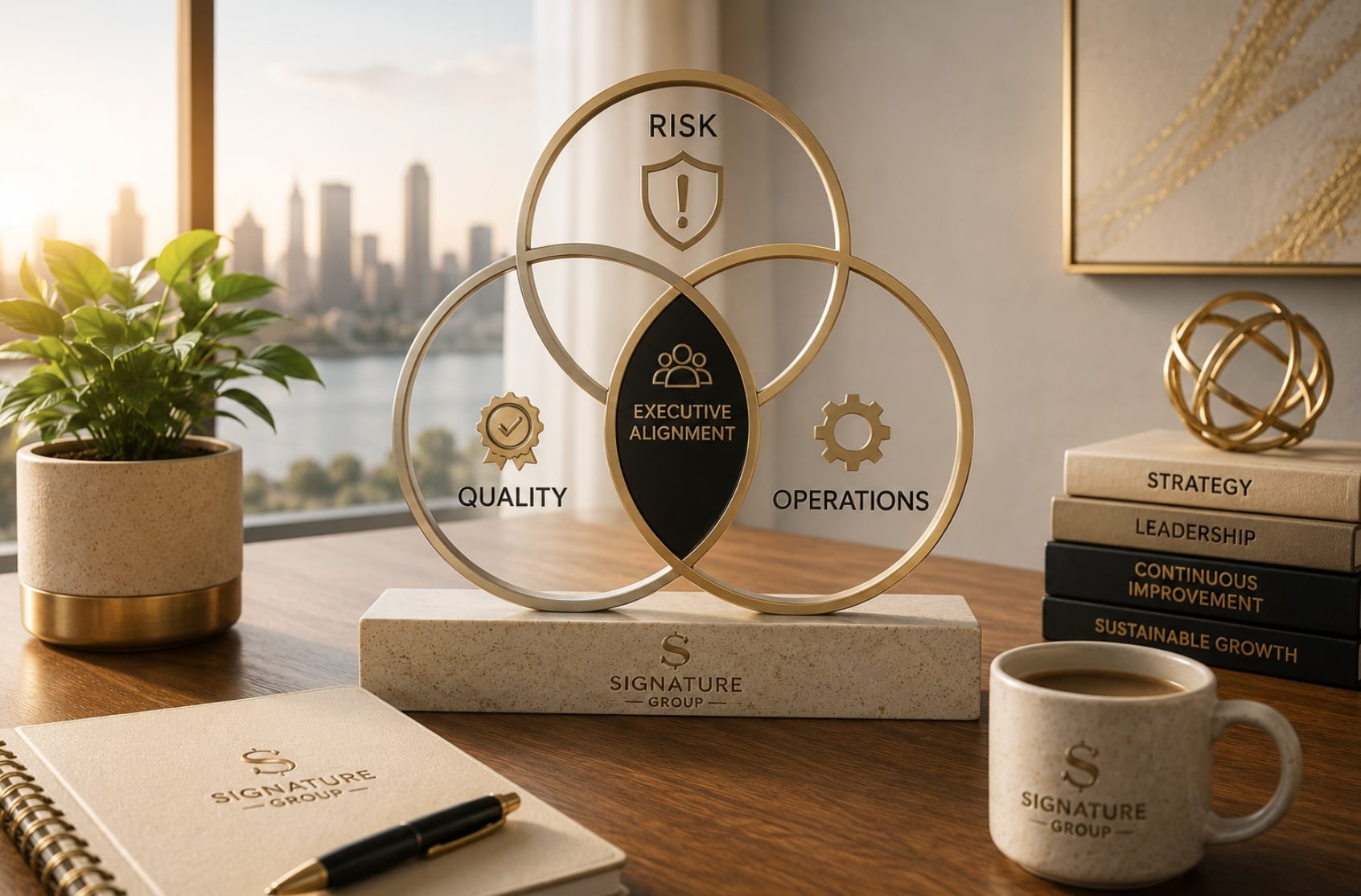
Risk, quality, compliance, and operations are frequently managed as separate disciplines. On an organizational chart, that separation may make sense. In business decisions, however, the boundaries are rarely so clear.
A supplier quality problem can become a production problem. A production problem can become a delivery problem. A delivery problem can affect customers and revenue. A regulatory issue can create operational restrictions, additional costs, or reputational exposure.
What begins as a “quality issue” can quickly become a business issue.
That is why risk, quality, regulatory compliance, and operational performance need visibility at the executive level.
When Risk Registers Become Administrative Exercises
Risk registers can become administrative exercises when risks are identified and scored without being connected to decisions, resources, or performance. Effective risk management goes further.
Leadership should understand not only what could go wrong, but also the potential operational and business consequences. Could a supplier failure interrupt production? Could inadequate competency create quality or safety exposure? Could aging equipment affect capacity or delivery? Could regulatory change require investment? Could recurring nonconformities indicate a larger process weakness?
These are not questions for one department alone. They influence resource allocation, strategic priorities, customer commitments, and financial performance.
Quality Data as an Early Warning System
Quality functions also possess information that can provide early warning of broader business problems. Customer complaints, supplier failures, deviations, nonconformities, corrective actions, audit findings, process trends, and performance against objectives can reveal weaknesses before they become major operational events.
The value of that information depends on whether it reaches the right decision-makers and whether it is presented in a way that supports action. Executive leadership does not need more data simply because it exists. Leadership needs meaningful information about trends, exposure, priorities, and business impact.
Connecting Governance, Strategy, and Operations
Strong governance connects these elements. It establishes who owns significant risks, how performance is reviewed, when issues require escalation, and how decisions and actions are followed through.
Management review, risk assessment, objectives, corrective action, change management, and performance monitoring should therefore operate as connected elements rather than isolated compliance activities.
Business strategy establishes where the organization intends to go. Governance and risk management help determine what could interfere with those objectives. Quality and operational systems provide controls for delivering them consistently. Regulatory requirements establish the boundaries within which the organization must operate.
When these elements are aligned, compliance supports strategy rather than competing with it.
Risk, quality, and compliance belong in executive decision-making because their consequences ultimately appear in operations, customers, reputation, and financial performance.
That is where an effective management system becomes more than a compliance framework. It becomes part of how the business is governed.